Building an e-commerce website is equivalent to walking through a long, winding maze of many choices, costs, and features. There seems to be rapid growth in online shopping, and the bulk of businesses are fast becoming visible online. But really, how much does it cost to create an e-commerce website? Below are some specific details that explain how and why the prices change.
Elements Influencing E-commerce Website Pricing
Your business model determines how much the web will cost you. Are you a small retail-oriented online shop or a big marketplace? That difference is gigantic in budget talk.
Business model
Your business model determines how much it will cost you to have a website. Do you run a little online retail store or a big marketplace? If you need a shopping app development, that difference is gigantic in terms of budget.
- Small online store: The initial costs typically range from $1,000 to $5,000 for boutique or niche shops. It usually includes basic design, essential features, and initial marketing efforts.
- Large marketplace: Platforms like Amazon or eBay need a lot of money to start, usually more than $50,000. These sites need important features like strong inventory management, customer accounts, and good search options.
Design complexity
The design of your website significantly affects user experience and overall expenses. More intricate designs mean higher costs.
- Custom designs: A custom design costs between $5,000 and $20,000. It makes a special and memorable experience, helping your brand be noticed. For example, a high-end clothing store would probably want a stylish, modern design to show who they are.
- Template-based sites: Using pre-made templates lowers upfront costs to about $500–$2,000. While these are quicker and more affordable, they may lack the customization to differentiate your brand.
Hosting and domain
Your choice of hosting provider and domain name also affects the budget.
- Hosting provider: The type of web hosting service you choose determines your hosting costs. The lowest price for a shared hosting plan starts at $10/month, while larger sites might require a managed hosting service that will cost between $100-$500/month. Extremely high-traffic websites often require both Premium hosting plans costing up to $1,000/month.
- Domain name: Typically, $10-$50 annually gets you a domain name; however, you may pay thousands for a premium domain. A catchy and memorable domain name enhances brand visibility but might cost a higher initial investment.
E-commerce Website Development Average Cost
So, how much does an e-commerce website cost? In general, you can expect to invest upwards of $1,000 and all the way up to over $100,000, depending on what you need from your site.
Here’s a rough breakdown of what that looks like:
- DIY platforms: With a bit of technical know-how, websites such as Shopify and WooCommerce enable you to create a very basic site for as low as $29 a month. Adding features and plugins increases the bill.
- Custom development: Hiring a developer for more robust features would cost anywhere from $5,000 to $30,000, especially when this has to do with custom features and integrations. An example would be that this online clothing store might want an online shopping experience like no other and could budget $10,000 for design and development, possibly with ongoing monthly hosting and maintenance thereafter.
Note: We at Cleveroad build high-performance, secure, and scalable e-commerce websites tailored to your business goals. Our team delivers full-cycle development including UX/UI design, architecture planning, integrations and optimization. We implement fast product search, flexible catalog management, multi-currency payments, automated inventory syncing, and secure checkout flows. Additionally, we integrate CRM/ERP systems, set up SEO-friendly structures, and apply analytics and personalization tools to boost conversions, customer retention, and operational efficiency.
Why an Investment in an E-commerce Site Can Pay Off
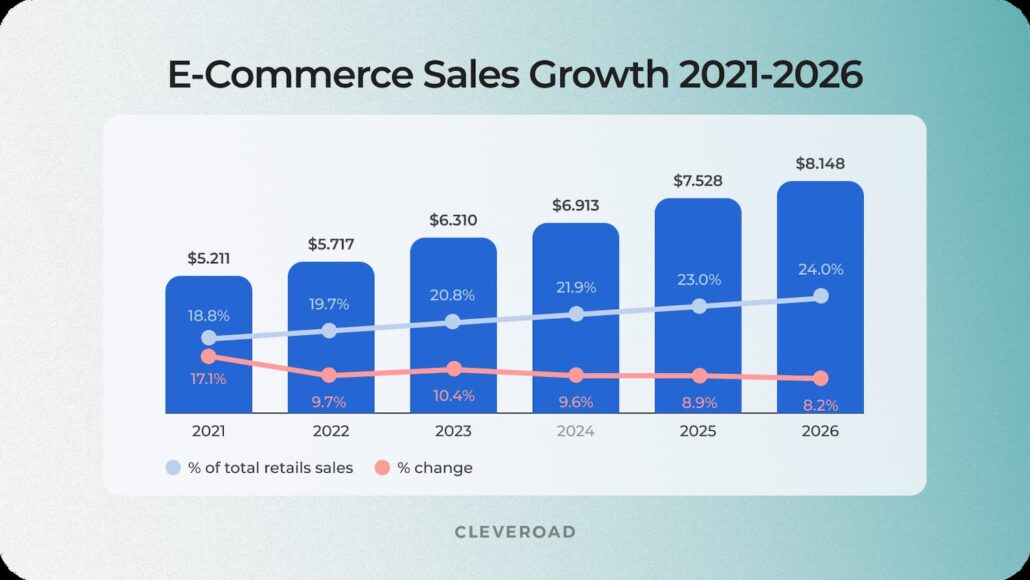
You might wonder whether the effort and money you spend on investment in an e-commerce website pays off. Absolutely, yes! Here are some compelling reasons to consider:
- Reach a global audience: Unlike a physical store, an e-commerce website lets you sell to customers anywhere around the globe. For instance, a local artisan can put on a show and sell various handmade items to buyers across continents, widening his market from his hometown. Such reach will help you greatly improve your sales potential and brand visibility.
- 24/7 availability: With e-commerce, your store will never close. Consumers could be purchasing in the hour of the day or at 4 AM in the middle of the night. For potential sale building, if your target sectors have a wider time zone distribution, the consumer would be awake where your company earned profit and would be fast asleep while asleep yourself. That gives you ample chance to generate money continuously from almost every second spent or lost.
- Insights on data: Huge e-commerce has equally matched platforms providing big analytics software through customer tracking. It can then be analyzed, thus providing the basis for adjusting marketing strategies and sales. For example, understanding the most popular products helps to optimize the stock of those products and hones the promotions in such a way that demand is just for what your customers like.
- Lower overhead costs: The typical operating costs of running an online store are usually much less than running a storefront. These range from saving money on rent to utility and in-store staff. This is why e-commerce is appealing to many of us entrepreneurs. You can just shovel a lot of the overhead, placing your investments more constructively to improve marketing, product development, or even customer service levels of potential growth of your business enterprise.
Thus, an e-commerce investment brings new windows of growth and success along; the result shall make it all worthwhile.
E-commerce Website Technology Stack
Your website’s technology stack is another important cost factor. Here are some things to consider:
- Front-end development: It’s the visual appearance of your site, built using HTML, CSS, and JavaScript. For more interactivity, frameworks like React or Angular will increase the development time and potentially the costs.
- Back-end development refers to server-side programming, databases, and application logic. These technologies could come into play, and each one will have very different price estimates: Node.js, Ruby on Rails, and PHP.
- Content management system: Choosing an appropriate CMS, such as WordPress with WooCommerce or Magento itself, will likely impact functionality and cost. The use of CMS will simplify content updating. Still, your startup probably needs some extra plugins or other integrations to complete e-commerce capabilities.
Wrapping Up
E-commerce website creation is a big deal and a considerable investment. However, knowing each cost variable will make you competent enough to make intelligent decisions. Whether you go for DIY or professional assistance, remember that business goals and customer needs come first. Spend wisely, and your e-commerce website will act as an enabler for growth and success in the present digital marketplace.
Frequently Asked Questions:
How much does it cost to make an e-commerce website?
In general, you can invest upwards of $1,000 and up to over $100,000, depending on what you need from your site.
Which aspects affect e-commerce website cost?
The most powerful aspects which affect e-commerce website costs are:
- Business model
- Design complexity
- Hosting and domain